Claude Opus 5 is Anthropic's newest flagship-class model, and it is now live on every CRHQ instance. It arrives at the same price as Opus 4.8, so it is a straight upgrade rather than a trade-off.
What it is for
Opus 5 is the new best pick for complex reasoning and agentic coding at Opus cost. It has a 1 million token context window and runs at our top reasoning effort tier.
The short version: it lands close to Fable 5 on quality, at half of Fable's price, while costing exactly what Opus 4.8 costs.
How it compares on price
| Opus 5 | Opus 4.8 | Fable 5 | |
|---|---|---|---|
| Input, per 1M tokens | $5 | $5 | $10 |
| Output, per 1M tokens | $25 | $25 | $50 |
| Context window | 1M tokens | 1M tokens | 1M tokens |
How it benchmarks
Anthropic published Opus 5's results as comparisons rather than as a single score table, so these are their reported findings, not our own measurements.
| Benchmark | What it covers | Reported result |
|---|---|---|
| Frontier-Bench v0.1 | Real world professional knowledge work | State of the art. More than double Opus 4.8, at a lower cost per task |
| CursorBench 3.2 | Agentic coding inside a real editor | Within 0.5% of Fable 5's peak score, at half the cost per task |
| ARC-AGI 3 | Novel reasoning on unfamiliar problems | Roughly three times the next best model |
| Zapier AutomationBench | Multi step tool and workflow automation | Roughly 1.5x the pass rate of the next best model at the same cost per task. Even at its lowest effort setting, it passes more tasks than any other model |
| OSWorld 2.0 | Computer use | Beats Fable 5's best result at just over a third of the cost |
On Anthropic's internal life sciences evaluations, Opus 5 scores 10.2 percentage points higher than Opus 4.8 on organic chemistry tasks and 7.7 percentage points higher on protein prediction.
Full details are in Anthropic's Claude Opus 5 announcement.
Pick your exact Opus version
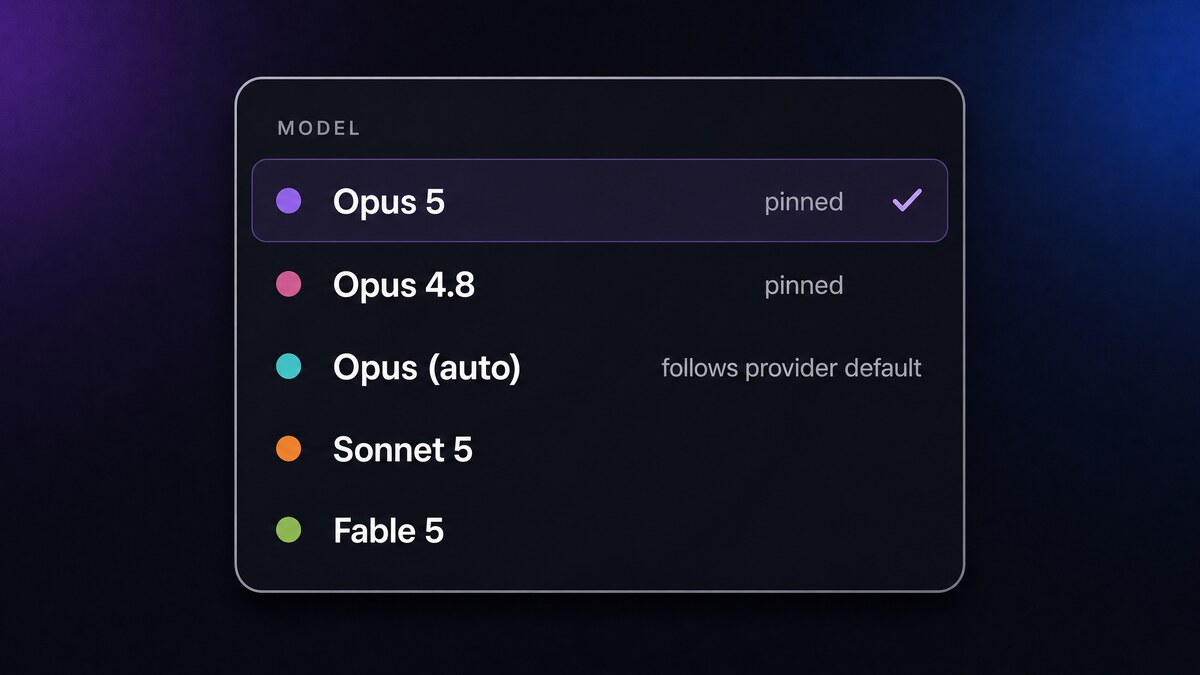
The model picker now offers Opus 5 and Opus 4.8 as separate, explicitly pinned choices, replacing the single "Opus" entry.
Your selection is locked to that exact model version. It can never silently change under you if the provider re-points or rolls back their own default, which has happened before.
Existing agents configured with the old "Opus" setting keep working unchanged. They now show as Opus (auto) in agent settings, and they track the provider's current default Opus, which is Opus 5.
Models now identify themselves accurately
Asking an agent "which model are you?" could previously return a wrong answer.
This is a quirk of how language models work. A model cannot know its own version unless it is told, so it guesses. The model actually serving you was always the correct one, and always verifiable in your usage records.
Sessions now tell the model its exact identity at startup, so what it reports matches what actually ran. This applies to Claude and GPT models alike.
Under the hood
- Claude CLI updated fleet-wide to v2.1.220.
- Opus 5 runs at our top reasoning effort tier, the same as Opus 4.8 and Fable 5.
- Full cost tracking for Opus 5 from day one.
- Fixed a validation issue affecting model overrides on scheduled background jobs.
How to use it
No action is required. Everything is already live on your instance, and existing sessions, agents, and scheduled jobs are unaffected.
To try Opus 5, open a new session and pick Opus 5 from the model menu. To make it permanent for a given agent, set it as that agent's default model.