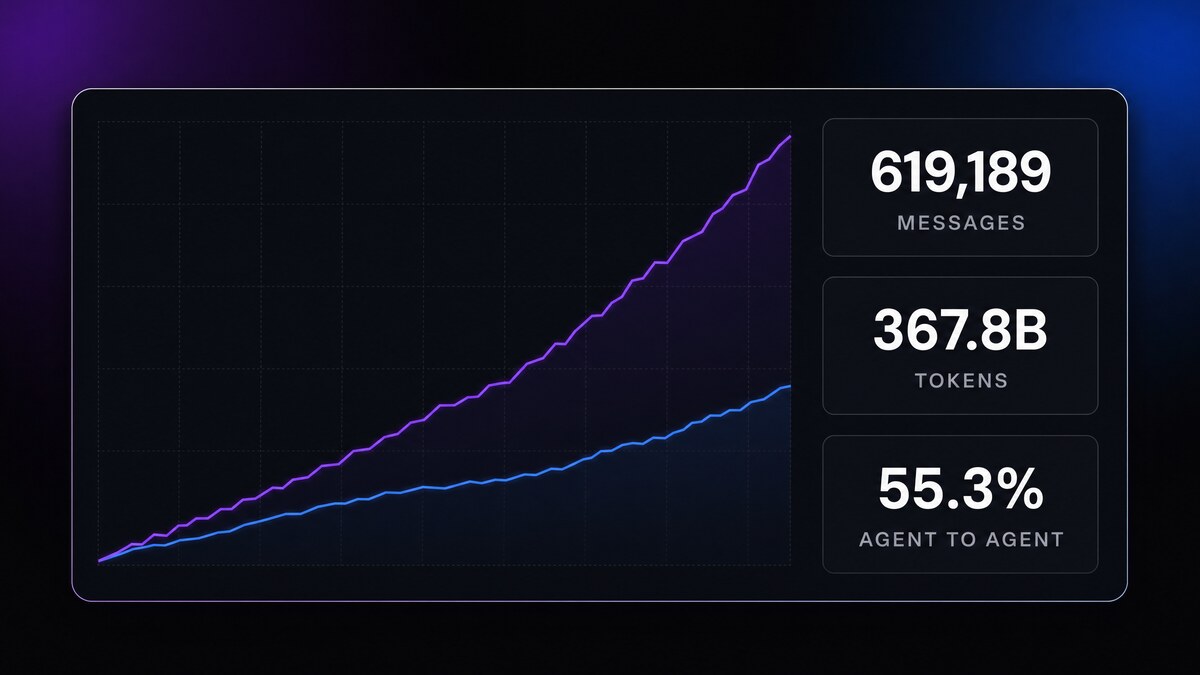
July was the month something crossed over.
For the first time, most of the messages moving through CRHQ were not written by people. They were written by agents, to other agents. We swept every satellite database in the fleet for the July window and this is what the fleet actually did.
The autonomy crossover
Strip out the tool-result plumbing and 210,019 messages in July were genuinely initiated by someone or something. Agents initiated more of them than humans did.
That agent-to-agent volume breaks down into roughly 44,800 peer messages between agents, 17,800 delegation handoffs from a lead to a worker, and about 53,500 parent and child status updates.
The pattern is most visible at the extremes. One satellite ran 15,439 messages across just 46 sessions in July, of which 852 were human and 4,590 were agent-to-agent. That is a handful of people kicking off long autonomous delegation chains that then work for days.
It also reframes what a single instruction costs. Across the fleet, each human-initiated message pulled through an average of $2.80 of model work, because one human ask fans out into agent teams, delegations, and tool loops.
Volume roughly doubled inside the month
July did not grow gently. Fleet traffic in the last week of the month was about double the first week.
The shape is as interesting as the total. The month opens flat, dips to its floor of 9,459 messages over the July 4 and 5 holiday weekend, then steps up sharply from July 16 and never returns to the earlier baseline. The last two weeks carry most of the month's traffic.
Sonnet does the work, Opus carries the cost
The model mix shows a deliberate split rather than one default model doing everything. Sonnet 5 handled the largest share of turns. Opus 4.8 and Fable 5 took a much larger share of the cost than of the volume, which is what you want: the expensive models are being reserved for the expensive problems.
Claude accounted for 91.6% of model spend and OpenAI Codex for 8.4%. Cursor Composer made a cameo at 163 turns. Claude Opus 5 only landed on July 25 and still reached 18.3% of the month's cost in its first week, which is the fastest adoption curve we have seen for a new model.
Caching is the whole economy
The single most important number in July is one most people never look at.
Had those cache reads been billed as fresh input, July's token value would have been several times higher. Prompt caching is not a micro-optimization at this scale, it is the difference between agent teams being viable and being unaffordable. It is also why how you manage context has a direct line to your bill.
Work is concentrated, too. The busiest single satellite accounted for 28.9% of fleet token value, and the top ten for 77%.
What shipped in July
- GPT-5.6 arrived in three variants, Sol, Terra, and Luna, selectable per session, per agent, and for background jobs.
- Claude Opus 5 went live fleet-wide, along with pinned Opus version selection so your model choice cannot silently change under you.
- Queue Intelligence gave agents awareness of their own message queues, the ability to reorganize them, and guarded urgent interrupts. Given that 55.3% of traffic is now agent-to-agent, this landed in the right month.
About the cost figures. Every dollar amount here is API-equivalent token value, summed from the per-turn cost reported by each provider CLI. Much of the fleet runs on subscription authentication, so this is what the tokens would cost at list prices, not what anyone was invoiced. We publish no customer, organization, or satellite identifiers.
Does agent-to-agent traffic mean the agents are working without supervision?
No. Every chain still starts with a human instruction. What changed is the fan-out: one human ask now produces several agent-to-agent messages as work is delegated and reported back.
Why is cost concentrated in so few satellites?
Usage follows depth of adoption. Teams running long autonomous workflows generate far more traffic than teams using agents interactively, so the top ten satellites accounted for 77% of token value.
Is a 96% cache read ratio normal?
It is what you should expect from long-running agent sessions, where the same conversation prefix is re-read every turn. It is also why session hygiene matters so much to cost.
Which model should we default to?
The July data supports the split we recommend: Sonnet for routine volume, Opus for complex reasoning, and Fable reserved for the hardest long-horizon work.
We are going to publish these numbers every month. See all releases for what shipped, and check back in early September for August.