AI coworkers are entering Slack, CRM, GitHub, docs, and support queues. Before you invite one in, ask the only question that really matters: who owns what it learns?
A recent Matthew Berman video about Claude Tag framed the risk well. The feature is useful, but it points at a bigger architectural question. Anthropic's own Claude Tag announcement makes the direction clear: AI agents are moving into the place where team work already happens.
Claude in Slack sounds harmless.
You tag it in a thread. It reads the conversation. It knows the project. It understands the people involved. It can pull from connected tools, break down the task, chase the follow-up, and keep working after you leave.
That is not a chatbot feature.
That is a new operating layer for company work.
And once an AI system becomes the place where work is interpreted, remembered, routed, and executed, the important question is no longer which model is best?
Because the model can be swapped.
The context graph is harder to move.
Your Slack threads, CRM notes, customer history, codebase, tickets, docs, decisions, permissions, workflows, and agent memory are not just inputs. Together, they become the living map of how your company works.
If that map lives inside one model provider's product, you are not just buying intelligence from that provider.
You are renting your company's operating memory back from them.
The Claude Tag moment
Claude Tag matters because it makes the future visible.
The next interface for AI is not a separate app where you paste context and hope for a useful answer. The next interface is AI inside the flow of work: in Slack, in the CRM, in GitHub, in support, in docs, in the systems your team already uses.
That is the right direction.
People do not want to manage ten AI tabs. They want work to move.
An AI teammate should be able to:
- follow a conversation,
- understand who is involved,
- connect to the right tools,
- remember relevant project context,
- act asynchronously,
- surface progress,
- and hand work back to humans when judgment is needed.
This is not science fiction. This is the direction every serious AI company is moving.
But the interface being right does not mean the architecture is safe.
The trap: convenience pulls your team into one place. Then that place becomes the memory, router, executor, and meter for your company's work.
Model lock-in is obvious. Context lock-in is dangerous.
Most teams already understand model lock-in.
One month Claude is strongest. Another month GPT is strongest. A coding model gets better. A provider changes pricing. A model is temporarily unavailable. A policy changes. A rate limit appears. A feature disappears.
That is normal platform risk.
But the deeper risk is context lock-in.
Context lock-in happens when the AI provider does not only answer questions. It also becomes the place where your company's work is understood.
It owns the thread history. It owns the memory. It owns the tool routing. It owns the agent behavior. It owns the execution loop. It owns the accumulated understanding of how your business works.
At that point, switching models is not the hard part.
Switching context is.
The real lock-in is not the model. The real lock-in is the work graph around the model.
The AI-native company needs a control plane
The answer is not to avoid AI teammates.
The answer is to separate the control plane from the model provider. That is the same principle behind orchestrating multiple AI models instead of betting the company on one.
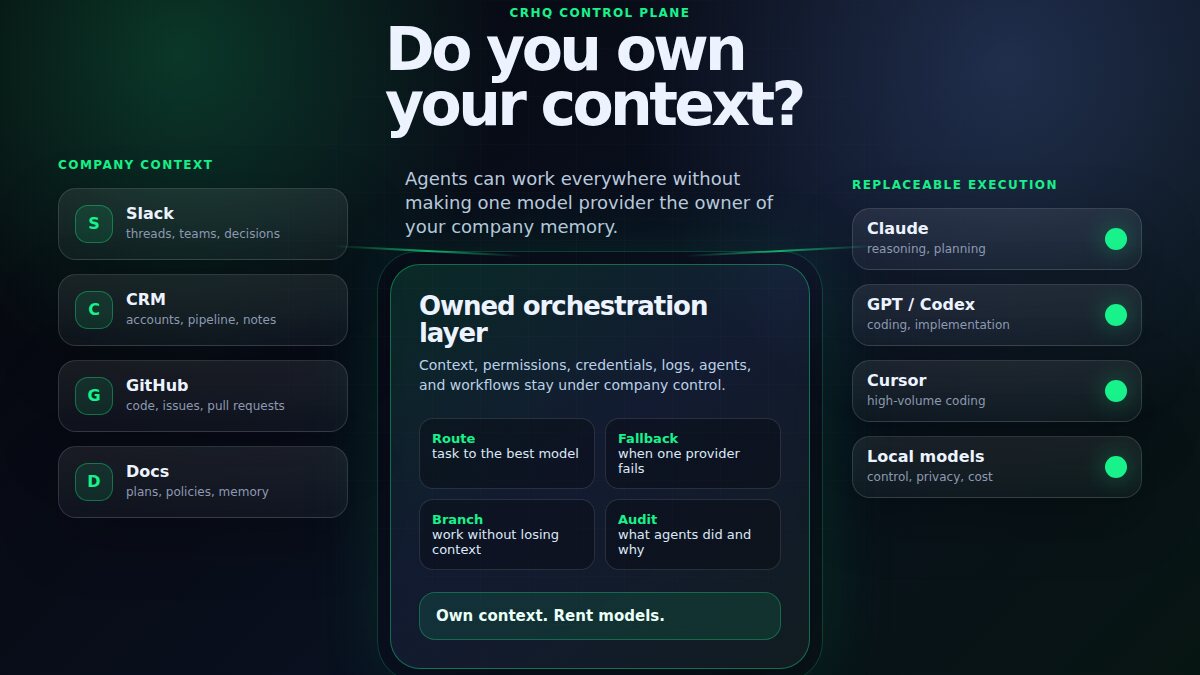
A company should be able to use Claude where Claude is best, GPT where GPT is best, Codex where Codex is best, Cursor where Cursor is best, and local or open models where those make sense.
But the company should own the layer that decides:
That layer is the harness.
That layer should belong to the company.
This is where CRHQ fits
CRHQ is built around a simple idea:
CRHQ is not another model. It is the coordination layer around models. The practical pieces already show up in CRHQ through model defaults across providers, branching a chat into a different model, and model-level cost tracking.
It gives teams the operating pattern that products like Claude Tag point toward: agents in the flow of work, connected tools, shared context, asynchronous execution, and team-level coordination. But it does not hardwire that future to one vendor.
In CRHQ, the model is replaceable infrastructure.
The company owns the context, the agent definitions, the credentials, the workflows, the logs, and the orchestration rules.
That means work can move across providers:
- Claude for one task,
- GPT for another,
- Codex for coding work,
- Cursor where that workflow fits,
- local models when control or cost matters,
- and fallbacks when a provider is unavailable.
If one model is down, work can continue. If a team uses more than one Codex account, CRHQ can also connect and switch between multiple Codex subscriptions. If one provider gets expensive, the architecture does not have to be rebuilt. If one model is better for planning and another is better for implementation, the system can coordinate both.
This is the difference between using AI and depending on an AI vendor for the operating system of your business.
The SaaS risk is real too
This shift does not only affect companies using AI.
It affects every software company.
As agents become the interface to work, users will spend less time inside SaaS dashboards. This is why teams need agent infrastructure that can connect to the systems where work already lives, including the kind of company-specific workflows CRHQ supports through custom skills. They will ask an agent to update the CRM, file the ticket, summarize the account, query the database, draft the proposal, or ship the code.
That means the value of software moves away from screens and toward workflows, APIs, permissions, data, and execution.
If one AI provider controls the agent layer, that provider becomes the gateway between users and every business application.
That is platform risk at a much larger scale than an app store or an API dependency.
It is work itself becoming mediated by one vendor.
The practical test
Before adopting an AI teammate for your company, ask five questions:
If the answer is no, you are not just adopting an AI tool.
You are moving your company's operating context into someone else's platform.
The future is not single-player AI
The AI-native company will not be built around one chat window.
It will be built around many agents, many tools, many models, and many workflows coordinated through one owned control plane. That is also why agent types and search matter: the more agents a company has, the more important it becomes to find the right one and route work deliberately.
That is the future CRHQ is designed for.
Use the best model for the job.
Let agents work where the work already happens.
Connect Slack, CRM, code, docs, support, databases, and internal systems.
But do not let one model provider become the memory and router for your company.
Own your context. Rent the models.
Sources
This article was prompted by Matthew Berman's video, Claude Tag is not what you think, and Anthropic's official announcement, Introducing Claude Tag.
What is context lock-in?
Context lock-in is when your company knowledge, workflows, agent memory, tool routing, and execution history become trapped inside one model provider's product.
Is the problem using Claude, GPT, or any specific model?
No. The risk is not a specific model. The risk is letting one provider own the context and orchestration layer around your work.
What is the safer architecture?
Own the control plane: context, agents, permissions, credentials, logs, and workflows. Then route tasks to the best available model provider for each job.
How does CRHQ help?
CRHQ gives teams a provider-independent orchestration layer for agents, tools, context, branching, model defaults, fallbacks, and coordination across multiple execution providers.