On 11 August, xAI launched Grok Bot in beta: always-on agents that each get their own computer in xAI's cloud, sign into your tools, and keep working after you close your laptop. They hold context across conversations, save watched tasks as routines, and coordinate with each other in group chats.
It is a good product, and it settles an argument. For two years the industry debated whether agents belong in a chat window or on a machine of their own. A frontier lab just answered with a launch: agents need a computer, running around the clock, with memory that survives the session.
We agree. CRHQ has run exactly this architecture in production since early 2026, roughly six months before Grok Bot's beta. Watching a frontier lab arrive at the same conclusion is the most validating thing that has happened to this category all year.
Which makes this the right week to talk about the part of the architecture xAI kept for themselves.
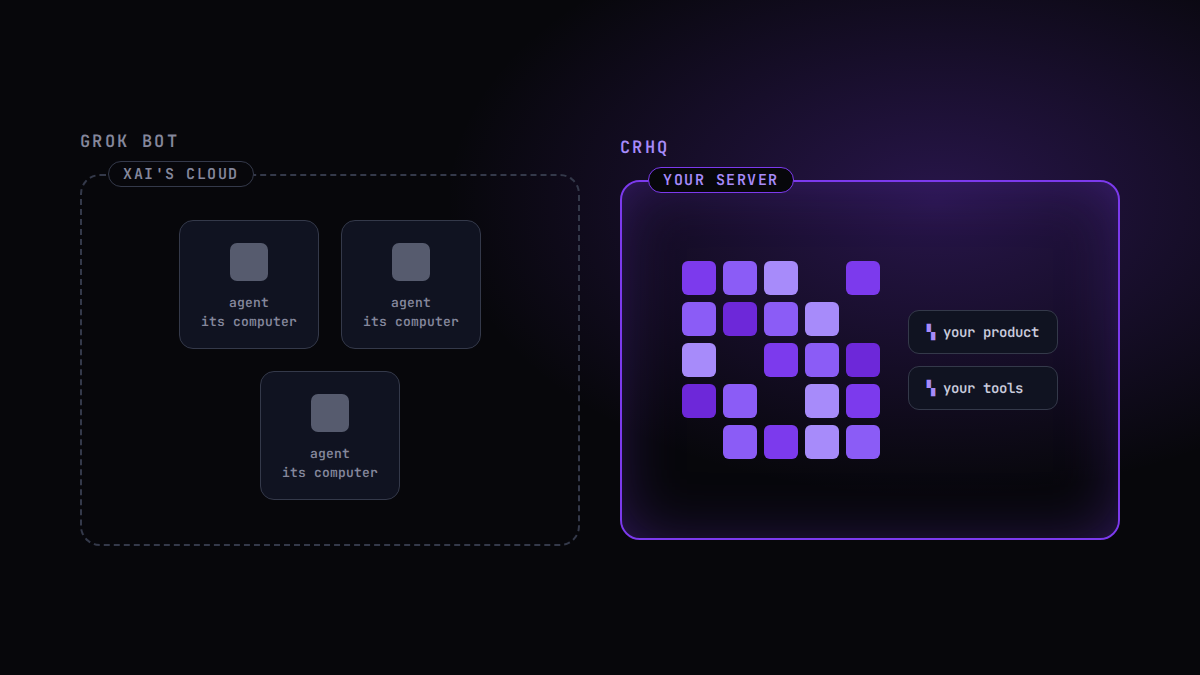
Grok Bot's answer is "ours." The agent's computer lives in xAI's cloud, runs xAI's stack, and is reachable through the subscriptions that bundle it. The launch materials name no model choice and no data-governance story. For personal task automation inside that ecosystem, this can be a fine trade.
CRHQ's answer is "yours." Every customer gets one dedicated server, managed and secured by us, owned in every practical sense by you. The whole fleet lives on it together, and three things follow from that.
Your agents can run any model. Claude, Codex, Grok, Gemini, routed per task, with open-source providers in reach. When a better or cheaper model ships, from any lab, your fleet switches. A single vendor's roadmap never becomes your ceiling.
Your agents can build. They have full access to the machine they live on, so they install what they need, extend their own capabilities, and host real software next to themselves. generatespecs.com is a shipped product that works this way: hosted on a CRHQ server, managed by agents on that same server, calling the harness for its agentic features. A Grok Bot can operate your tools. It cannot hand you its computer.
Your data has an address. It sits on one machine, and you decide what enters and leaves it. When a client asks where their information lives, the answer is a server you can point at, in a sentence.
For builders, the difference compounds. An agent on a rented computer stays an assistant. An agent on your server becomes infrastructure: it accumulates skills and recipes, grows a knowledge base you can open and edit, joins a team under an orchestrator, and eventually runs whole workflows from a schedule. That ladder only exists when the machine underneath belongs to you.
So take Grok Bot seriously. It is a frontier lab confirming that agents deserve machines, memory, and autonomy. Then ask the machine question, because it is the one that decides what you can build on top.
We wrote up the full side-by-side, feature by feature and price by price, in Grok Bot vs CRHQ. If you are ready to put a fleet on a server of your own, schedule a demo and we will show you one running.