What is an agent harness?
Last updated: November 24, 2026
Finally, agents join the workforce, and the agent harness is how.
An agent harness is the software around an AI model that gives it tools, memory, files, a browser and schedules, so it can carry out real work.
CRHQ is the most advanced agent harness in the world.
"I guarantee it's going to blow your mind."
You describe the workspace your company needs, and an agent builds its first pages in minutes, while you watch. That is your starting point.
Start your 7-day trial today.
7 days for $19.
The model thinks. The harness lets it work.
An AI model, such as Claude or GPT, reads and writes. Ask it a question and it answers. By itself it cannot open a website, save a file, remember what you told it last week or start a job at eight in the morning.
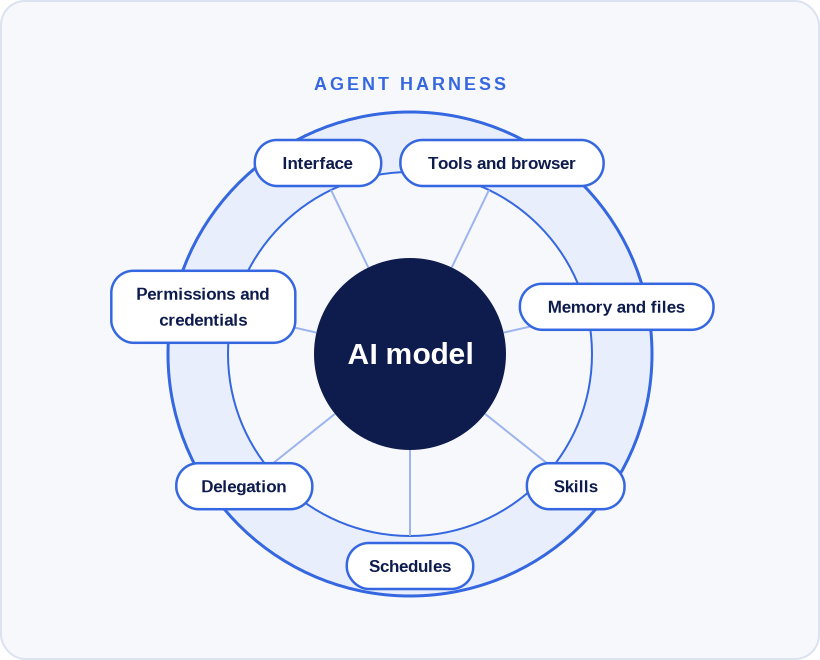
An agent harness adds what work needs: tools, a browser, memory, files, schedules, permissions and a place where people and agents meet. Put a model inside a harness, give it a role, and you have an agent. It takes a task, does the steps, checks the result and reports back.
Why this matters now: 78% of firms use AI, and 83% of executives report no impact on productivity yet (NBER Working Paper 34836, 2026). One person with an agent gets a lot done. A team does not: everybody works in their own chat, and the work never comes together. A harness is where it comes together.
Every company deserves its own agent harness.
Agent harness architecture: the seven parts
1. Tools and a browser. A harness lets the model act. It can run commands, call other software, and open a browser to use a website the way a person does. In CRHQ, agents have browser automation, a file system and a database, on a server that belongs to your company alone.
2. Memory and files. A model starts every conversation with nothing. A harness gives it a place to keep what it learns. In CRHQ, each agent has its own set of files and folders that it reads into its context: its activity log, its knowledge, your preferences. Its context grows with use.
3. Skills. A skill is know-how written down once: how your company writes a proposal, publishes a post or closes the month. The agent picks the skill up when a task calls for it. In CRHQ you add as many skills as you need.
4. Schedules. Work that repeats should not wait for someone to ask. A harness starts it on time. In CRHQ you set jobs to run once or repeat on a schedule, and your agents work in the background.
5. Delegation between agents. One agent rarely does everything well. A harness lets agents hand work to each other. In CRHQ you build a team: agents talk to each other and hand off work, and a lead agent passes each job to the right one.
6. Permissions and credentials. Agents need logins and keys. People need limits. A harness keeps the first and sets the second. CRHQ has a vault for logins and keys, and roles and permissions define who can access which agents, which sessions and which pages.
7. An interface. This is where people meet the agents. In most harnesses it is a chat window or a terminal. In CRHQ it is also Canvas: custom pages, flexible data, agent widgets, connectors, roles and permissions, and your own branding. You don't build any of this. You describe it.
What an agent harness does in a real week
On our founder's own servers, the standing rhythm is "market briefings and YouTube recaps every morning, inbox sweeps every four hours, anomaly scans". Those words come from a live page written from one week of session logs: One week of agents at work.
None of that is a chat. Each job has an agent with a role, a schedule that starts it, and the files and memory it needs. The person stays in charge. Our founder: "In my own setup, every post, payment and public step still waits for my OK."
Close the laptop, and the work goes on. In the morning, the decisions are waiting.
Agent harness, model, framework, agent: what is what
| Term | What it is | In practice |
|---|---|---|
| AI model | The intelligence. It reads, reasons and writes. | Answers a question, drafts a text, plans the steps. |
| Agent framework | Code that developers use to build their own agents or their own harness. | A set of parts you assemble, host and maintain yourself. |
| Agent harness | The working environment around the model: tools, memory, files, schedules, permissions, interface. | Lets the model carry a task from the request to the finished result. |
| Agent | A model at work inside a harness, with a role. | "An agent is like a person you hire, then onboard into a role." (Andrej Simunaj) |
A framework gives you the parts. A harness is the working whole.
Examples of agent harnesses
"Agent harness" is the name the field has settled on for this kind of software. The makers mostly describe their products in their own words. Here are those words, read on 23 November 2026.
- Claude Code, by Anthropic: "Claude Code is an agentic coding tool that reads your codebase, edits files, runs commands, and integrates with your development tools." (Claude Code documentation)
- Codex, by OpenAI: "Codex accelerates real engineering work, from planning and building features to refactors, reviews, and releases." (openai.com/codex)
- OpenClaw, open source: "OpenClaw is an open-source AI assistant that runs on your own computer and meets you in the channels you already use". (OpenClaw on GitHub)
- Hermes Agent, open source, by Nous Research: "The self-improving AI agent built by Nous Research." (Hermes Agent on GitHub)
- CRHQ: a managed agent harness for whole teams. Your company gets its own dedicated server, we run it, and everything you build on it is yours.
For a closer look, side by side and with sources, see how CRHQ compares.
Build, use or package a harness
The world of agentic systems has five layers, and it helps to know which one you are in.
- Build. A few teams build a harness from scratch. It is their product.
- Use. Most companies do better using a harness and building their own agents, skills and workflows on top of it.
- Package. Agencies and experts shape a harness for one niche and offer it under their own brand.
- Deploy. Businesses bring AI teammates into their workforce.
- Consume. Everyday people use AI assistants.
CRHQ is the harness you use, and the harness you package: agencies put their name, logo and domain on it and give each client a dedicated server.
Thinking of building your own? Every hour and every token you spend on a harness is time not spent on your business. In our founder's words: "Don't build your own AI tools. Don't manage your own agent harness. Focus on your core work."
Read more: How the world of agentic systems is layered, and where you fit.
How to choose an agent harness: six questions
1. Who runs the server? Someone has to install it, secure it, back it up and keep it current. With CRHQ that is us: we set up and run the server, with security updates, certificates, backups and upgrades. It is your own dedicated server.
2. Which models can it use, and who pays for them? Models change fast, so ask whether you can switch. In CRHQ you choose a model for each new session and give different agents different models. You connect your own Claude or ChatGPT subscription and pay the provider directly.
3. Does it work for a whole team? A harness for one person is a different thing from a harness for a company. In CRHQ your whole team logs in, roles and permissions control who sees what, and agents hand work to each other.
4. Can you shape it to your company? Your team should not have to learn a system. In CRHQ you describe how your company works, and the Theme Builder agent builds the pages, the data and the agents around it.
5. Who owns what you build? Ask what happens if you leave. "All of your agents, skills, documents and files are 100% yours." "You are not locked in; you can move at any time." (Andrej Simunaj) How your data is governed is your decision.
6. What does it cost? Ask for one clear number. CRHQ starts at $299 a month per server. One price, everything included. AI subscriptions are billed separately by your provider.
Agencies and consultants: see white label.
Questions about agent harnesses
What is an agent harness in AI?
An agent harness is the software around an AI model that gives it tools, memory, files, a browser and schedules, so it can carry out real work. The model does the thinking. The harness gives it a place to work, things to work with and rules to work by.
What is the difference between an agent harness and an agent framework?
An agent framework is code for developers: parts you assemble into your own agent, then host and maintain. An agent harness is the working environment itself. With a managed harness such as CRHQ, nobody on your team has to assemble or maintain anything.
What is harness engineering?
Harness engineering is the work of shaping what surrounds the model: which tools it gets, what it is told, what it remembers and how its work is checked. OpenAI's engineers used the term as the title of their article "Harness engineering: leveraging Codex in an agent-first world".
Is Claude Code an agent harness?
Anthropic calls Claude Code "an agentic coding tool that reads your codebase, edits files, runs commands, and integrates with your development tools". That is the job this page describes, for software development: it gives a model the tools to do real work. Many people therefore call it a coding harness. Anthropic's own word is tool.
Do I need to build my own agent harness?
No. You can, and if a harness is your product, you should. If it is not, use one. CRHQ gives you a managed harness on your own dedicated server, and your team's time goes into your agents and your business.
What is the best agent harness for a business?
We say CRHQ: the most advanced agent harness in the world, built for whole teams, on a server of your own. Use the six questions above on any harness you look at, ours included. Then see it for yourself: start a 7-day trial, or book a demo with our founder.
This is how AI finally joins the workforce.
Start your 7-day trial today.
7 days for $19.