One week of agents at work
It is genuinely hard to explain what a fleet of AI agents does all day. So instead of explaining, we pulled seven days of real activity from our founder's own two servers — every session, every artifact, every scheduled job — and wrote it down.
Nothing below is hypothetical. Every example comes from session logs for the week of July 30 – August 6, 2026: 45 named agents across a personal build server and a business-autonomy server, run by one person.
Counts measured directly from the two servers' databases for Jul 30 – Aug 6, 2026. The 73% figure is these two servers' July share of agent-initiated vs human-initiated messages.
And the part that reframes all of it: this particular week, the operator was on vacation — a villa with family and friends, working a few part-time hours a day. Most direction was given by voice, from a phone, during random downtime; the laptop came out for an hour or two. Everything on this page is what the agents did with that.
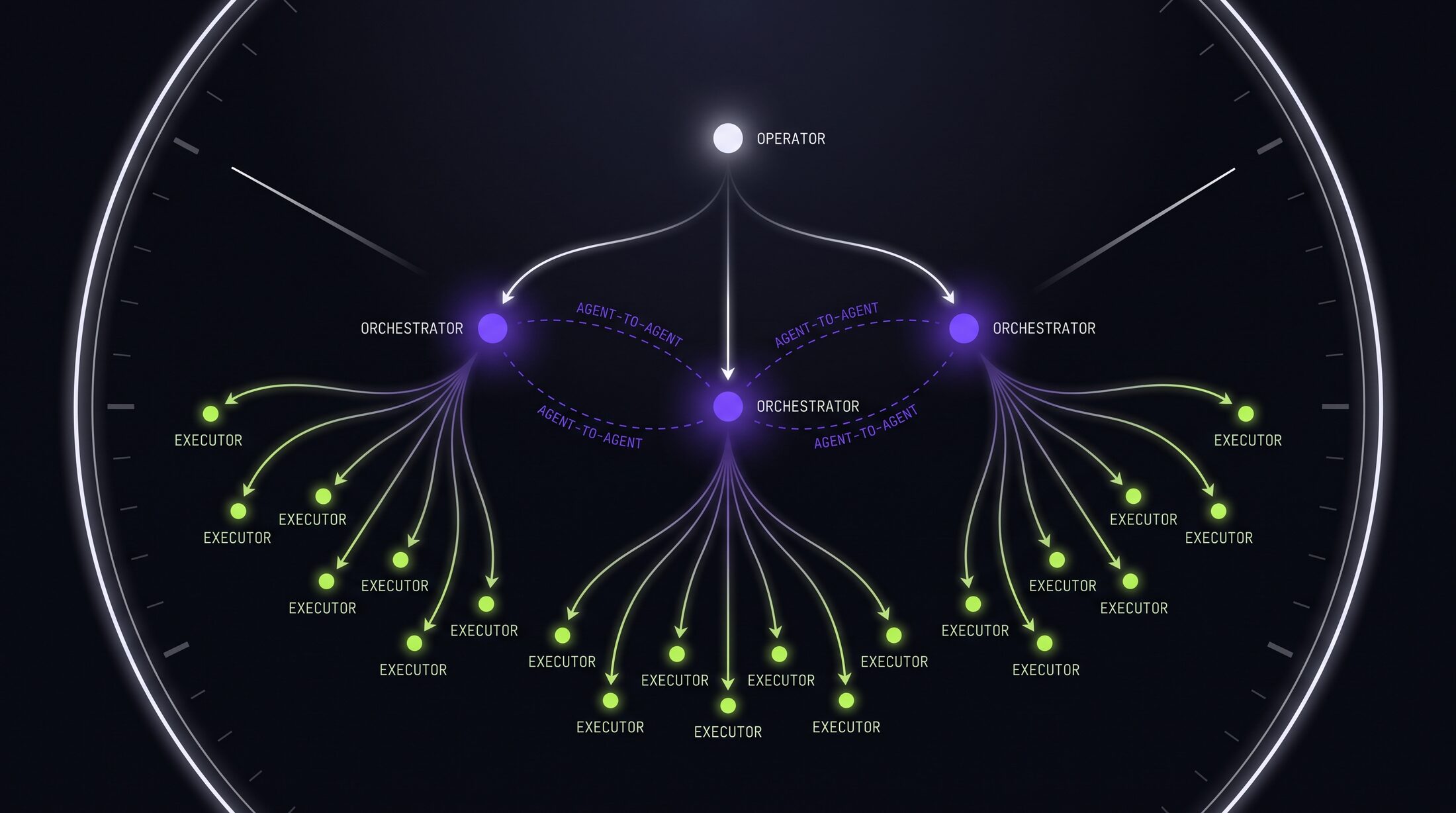
The human acts like a CEO. The agents act like a company.
Reading a week of messages makes the division of labor obvious. The human sets direction, approves decisions, tests what shipped, and hands over credentials when an agent needs a door opened. The agents do everything else — and mostly talk to each other about it.
"Execute all the way to canary validation and if that goes completely well then fleet prep. Then give me a report, explain to me what was built and tested in simple terms."
Direction, not micromanagement
Typical human messages: "Ok let's proceed" · "Build everything as recommended" · "I'll trust your judgement" · "Explain it in 10th-grader language before I green-light it." The human reviews plans and risks; agents own execution end-to-end.
Decision queues, not interruptions
Agents accumulate what they need into standing lists — "what needs a decision from you (9 open)", a daily human-leverage queue of things only the human can do. Nothing blocks while it waits.
Artifacts as the reporting layer
113 artifacts in seven days: live status trackers, decision briefs, root-cause analyses, client-ready replies, migration dashboards. The human skims a page, not a transcript.
Agents managing agents
Orchestrators delegate to executor agents, watch their queues, restart stalled work, and run 20-minute watchdog sweeps overnight. On these servers in July, nearly three of every four initiated messages were agent-to-agent.
Meet the fleet
These aren't chat windows. Each agent has a name, a role, its own instructions, memory that survives between sessions, and — for many — a schedule it wakes up on whether or not anyone is watching.
🐇 White Rabbit
Wakes every two hours and boots from its own layered "brain". In one week it: tracked nutrition from photos and voice notes, maintained a private journal, ran investment research through delegated analyst agents (SpaceX vs. Tesla/Nvidia valuation study), drafted and scheduled X posts, researched and then commissioned a working Android screen-recorder app the same day, and turned a research thread into an installable "art of copywriting" skill for other agents to use.
🏗 Project Builder
- GeneratePRD.com — took a voice-note idea to a live product in days: wrote the PRD, got its own server provisioned, set up DNS, SSL, transactional email and GitHub sign-in, then wired resident agents to generate specs for customers. A product built by agents whose product is agents doing work.
- StayingAPI.com — analyzed the first paying customers' usage and margins, answered support and partnership emails, and wrote the runbook a marketing agent now executes weekly.
- A retail-deals engine for a client — scraping infrastructure with anti-detection browsers, staging deploys, and UI fixes driven by the client's phone screenshots.
🎮 Game Studio
Builds "Volt", a 3D browser game. The human plays on his phone and sends screenshots ("this pillar is floating", "the grotto has no entrance"); the studio coordinates fixes across delegated developers, generates 3D assets through an external API, and runs its own QA: a 316-check boot test, level-quality gates, payload budgets, and overnight watchdog ticks every 20 minutes. Level 3 was concepted, built, play-tested and polished inside this one week.
📣 TranscriptAPI Product & Growth Agent
Owns marketing for TranscriptAPI.com. Its week: a backlink outreach queue firing on a 20-minute cadence within pre-approved limits, weekly SEO strategy that reads its own learnings log first so it never repeats a mistake, daily Stripe earnings reports, growth-sprint heartbeats every six hours, and a directory-submissions sprint board. The human appears mainly in its "needs a human" queue.
🛠 CRHQ Platform Engineer
Maintains the platform itself and the whole fleet: diagnosed incidents from client screenshots, shipped security fixes through canary-then-fleet discipline, retrieved a client's off-site backup and served it through a secure time-limited download, fixed a data-loss edge on 18 affected hosts, and kept every deploy verified with an automated fleet-wide sweep.
📊 Product Managers
Each product has resident agents: anomaly watches every four hours against metric baselines, daily billing-entitlement reconciliation, dunning verification, ads management with cron-health self-checks, MCP registry listings, and morning decision queues. Four SaaS products' operations, effectively unattended.
👁 The Watchers
A daily real-estate scout watching one specific Zagreb neighborhood for apartment listings. A weekly SEO verifier. Soak monitors after risky deploys. Single-purpose "acceptance check" agents spawned with a self-contained brief, reporting to their project manager, then disappearing. Morning market briefings and YouTube channel recaps, every single day.
✍️ The Bench
Copywriter, Designer, Security auditor, Research, Testers, Sys Admin, Skill Builder (builds new capabilities for other agents), Recipe Builder (turns successful sessions into repeatable procedures), and empty-shell Executors that orchestrators dress with context per task. 45 named agents in total.
🆕 Hired this week
A CRM-marketing agent was created mid-week. Its first act: interview the human with a structured setup questionnaire — an agent onboarding itself into the org. Adding "headcount" is a ten-minute operation.
Inside one agent's brain
What makes an agent like the TranscriptAPI Product & Growth agent different from a chat window?
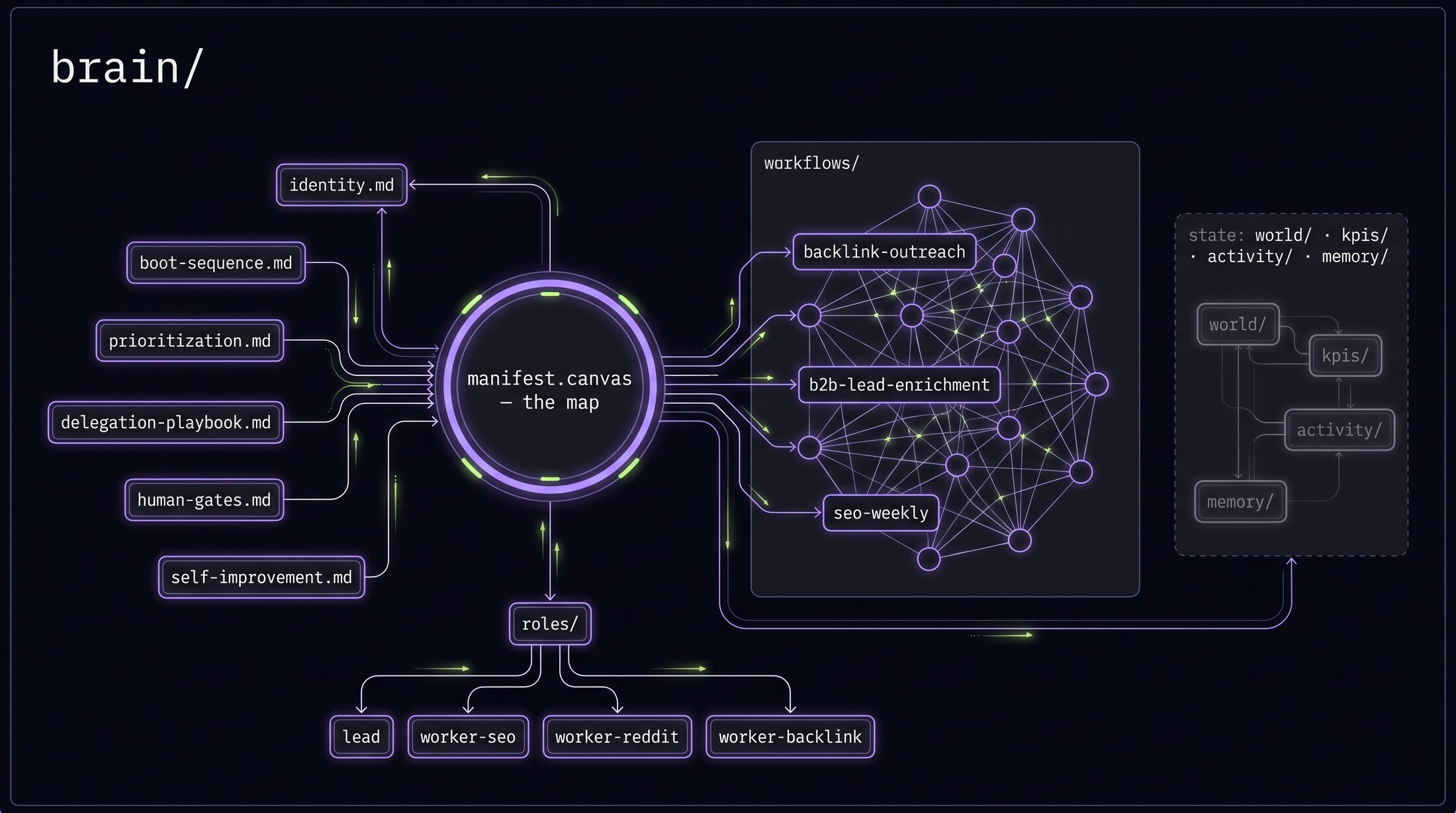
Its entire behavior lives in a folder called brain/ —
written in plain documents, versioned like code, and readable by the human at any time.
This is the actual structure, from the actual server:
The map, not a mega-prompt
manifest.canvas is a graph connecting everything the agent knows how to do. At boot it reads the map plus a few core documents — identity (who I am, what I never do), boot sequence (how I wake up), prioritization (how I pick my next task) — then loads only the workflow it's actually running. Small context, sharp focus.
One brain, several hats
Role cards let the same brain run as a lead (plans, delegates, reports) or as narrow workers — worker-seo, worker-reddit, worker-backlink — each waking on its own schedule with a deliberately small job. The 20-minute backlink sender is the same agent, wearing its smallest hat.
Workflows that mature
Fifteen-plus procedures — backlink outreach, B2B lead enrichment, weekly SEO — each with its own mini-canvas. Every workflow has a lifecycle: planned → scaffolded → executable → mature. New capabilities start as sketches and earn autonomy through use.
Human gates, in writing
human-gates.md is an auto-generated index of every action that requires the human's sign-off — sending money, first contact with a stranger, changing prices. The boundary between "just do it" and "ask first" isn't vibes; it's a file you can read and audit.
It learns on the record
The weekly SEO run starts by reading its own learnings log so it never repeats a documented mistake. And the agent can improve its own brain — but only through one gated self-improvement path, reviewed like a code change.
Behavior ≠ state
The brain changes rarely, like source code. What changes constantly — the world model, KPIs, activity registry, session memories — lives in separate folders the brain reads at boot. That split is why the agent stays coherent across hundreds of sessions.
Seven days, abridged
A sample of what actually happened, day by day. Everything below ran alongside the standing rhythm: market briefings and YouTube recaps every morning, inbox sweeps every four hours, anomaly scans, backlink sends, and White Rabbit's two-hour ticks.
Thursday JUL 30
- StayingAPI agent analyzed the first four paying customers — usage, unit costs, ICP — and wrote the weekly runbook a marketing agent now executes.
- Platform engineer retrieved a client's off-site backup from object storage and built a secure, expiring download page so the client's own agent could fetch it directly.
- The human dictated life-planning and journal entries to White Rabbit while driving; the agent filed, structured and cross-referenced them.
Friday JUL 31
- The GeneratePRD idea arrived as a voice note. By evening: PRD written, dedicated server provisioned, DNS configured at the registrar, SSL and transactional email live, deployment running.
- Platform engineer investigated three client-reported platform bugs from screenshots, patched, and published a skill-bundle update to the whole fleet.
- A one-off acceptance-check agent verified a scraping fix against its written brief and reported to its project manager.
Saturday AUG 1
- GitHub OAuth sign-in wired into GeneratePRD; the free-first-100 funnel configured.
- White Rabbit researched whether to integrate two more AI-model CLIs into the stack and returned an integration verdict artifact.
- Game Studio fixed a dozen play-test findings from phone screenshots — floating pillars, spawn points, pass-through terrain.
Sunday AUG 2
- Volt Level 3 concept approved and built the same day — new biome, new portal, new mechanics.
- White Rabbit asked for a private screen recorder; an agent researched the approach and shipped a working Android app (with export controls added on request) within hours.
- Fleet-wide platform deploy: scoped API keys with per-agent allowlists, verified across the whole fleet automatically.
Monday AUG 3
- Marketing copy for GeneratePRD rewritten via a four-model copy contest — proposals rated side by side, winner shipped.
- Delegated analysts produced a SpaceX vs. Tesla/Nvidia/Alphabet valuation study as a chart-heavy artifact.
- The monthly "July in CRHQ" blog article was researched by one agent (all-fleet database sweep) and written by another — agent-to-agent handoff with editorial guardrails.
Tuesday AUG 4
- An agent decommissioned legacy infrastructure after a two-week soak period it had scheduled for itself.
- Client-requested platform tasks pulled from the shared task hub, planned, executed, committed, closed.
- StayingAPI agent created and published a new open-source MCP repository for hotel & vacation-rental data.
Wednesday – Thursday AUG 5–6
- StayingAPI agent wrote a developer-handover pack — docs plus password-protected credentials — for a new agent on another server. Agents onboarding agents.
- Research into "why AI website copy sounds like slop" became an installable copywriting skill, reviewed and packaged for the fleet.
- Game Studio ran overnight watchdog arcs — 20-minute self-checks deriving ground truth from processes and git state — closing its backlog to a clean slate before Level 4.
- A new Personal Agent template was finished and published to the hub for every server in the fleet.
What they can actually touch
Every row below was exercised during this one week — not a roadmap, a log.
SSH into any server in the fleet, provision new VPS machines, configure nginx and SSL, manage processes, run canary-then-fleet deployments with automated fleet-wide verification sweeps.
Create DNS records at the registrar, point new domains at new servers, verify email-sending domains.
Run real inboxes: triage incoming support and partnership mail on a four-hour sweep, draft and send replies, set up transactional email for new products.
Daily Stripe earnings reports, dunning follow-up verification, entitlement reconciliation against the billing database.
Full products end-to-end: PRD → repository → implementation → QA gates → staging → production, including GitHub repos, OAuth apps, deploy keys and error monitoring.
Drive real browsers — including anti-detection browsers — for testing, scraping and data collection.
SEO strategy with self-maintained learnings logs, rate-limited outreach queues, directory and registry submissions, social posting, ad management with self-checks.
Multi-agent research fan-outs with cited, chart-heavy reports: market analysis, competitive teardowns, technology-integration verdicts, valuation studies.
Daily YouTube-channel recaps via transcript APIs, morning market briefings, blog articles with data visualizations, copy contests judged across multiple AI models.
Off-site backup management, restore preparation, secure expiring client-delivery links, and their own backup-health monitoring.
Nutrition tracking from photos, journaling, reminders keyed to real-world events, life admin, and same-day custom tools when off-the-shelf apps annoy the human.
Agents write skills for other agents, turn successful sessions into reusable recipes, and publish both to a central hub that distributes them fleet-wide.
These two servers, over a full month
Zooming out from one week to all of July — measured on exactly the two servers this page describes, run by one person:
Where the 51,717 messages go: 17,527 initiated messages (someone starting or steering work), 18,202 agent replies, and 15,988 tool-result payloads — the mechanical output of agents actually using tools.
Of every ten initiated messages on these servers in July, barely three came from the human. The other seven were agents briefing, delegating to, and checking on each other — 73% agent-to-agent. The org chart is real.
What it takes to run this
Three honest observations from the logs, because slideware never shows you these:
1 · The human still matters — differently
Judgment, taste, approvals, credentials, and testing what shipped. The week's logs show a person who reviews risk explanations before green-lighting, plays the game before calling it done, and reads the decision queue every morning. What disappeared is the execution work, not the leadership work — which is exactly how all of this fit into a few vacation hours a day, mostly dictated into a phone.
2 · Structure beats prompting
The leverage comes from architecture: agents with persistent roles and memory, orchestrators that delegate, schedules that keep working at 3am, skills that encode how-to once and distribute it everywhere, and artifacts that make output reviewable. None of that is a clever prompt. It's an operating system for agents.
3 · Trust is earned in production
The same week includes agents being tested, corrected, and audited — canary servers before fleet rollouts, soak monitors after deploys, read-only investigation rules, permission-gated destructive actions. Autonomy here is graduated, not blind.