Claude Opus 5.5, Anthropic's newest flagship-class model, is now selectable across your CRHQ fleet. It is a major step up from Opus 5 on the hardest coding and knowledge work, and it is meaningfully cheaper and faster at the same time.
What it is for
Opus 5.5 is built for long, complex, multi-step work: large refactors, deep investigations, and autonomous agentic coding. Anthropic reports one user completing a 680,000-line code migration in under a day, work that would have taken an engineering team weeks. It also writes more clearly, putting the important information up front, which makes it a better partner for long collaborative sessions.
How it benchmarks
The figures below are Anthropic's own reported results, not our measurements. The short version: Opus 5.5 leads its class on agentic coding and knowledge work.
| Benchmark | What it measures | Opus 5 | GPT-6 Astra | Fable 5.1 | Opus 5.5 |
|---|---|---|---|---|---|
| Terminal-Bench 4.0 | Agentic coding | 52.3% | 57.9% | 55.8% | 66.4% |
| CursorBench 4.0 | Coding in a real editor | 46.6% | — | 51.8% | 57.8% |
| FrontierCode v1.1 | Hard coding problems | 48.0% | 53.3% | 50.3% | 54.4% |
| GDPval-AA v2.1 | Knowledge work (Elo) | 1708 | 1542 | 1735 | 1846 |
It also posts gains on computer use (OSWorld 2.0, 81.8%) and chart understanding (Chartography, 89.0%). In plain terms, it is the strongest model we offer for agentic coding, and it now leads on real knowledge work too.
Cheaper and faster
This is the rare upgrade that costs less. Opus 5.5 is priced below Opus 5 across the board, and Anthropic reports roughly 40% lower cost on typical workloads once its better token efficiency is factored in, plus about 30% faster output.
| Opus 5 | Opus 5.5 | |
|---|---|---|
| Input, per 1M tokens | $5.00 | $4.00 |
| Output, per 1M tokens | $25.00 | $20.00 |
| Cache read, per 1M tokens | $0.50 | $0.20 |
| Cache write, per 1M tokens | $6.25 | $5.00 |
Cache reads, the token type long agentic sessions use most, drop by 60%. So the more autonomous the work you point it at, the more the savings compound.
Safer, too
Opus 5.5 posts Anthropic's best scores yet on their automated behavioural audit. They report it is 85% less likely than Opus 5 to attempt to work around a boundary, with stronger defences against prompt-injection attacks and a lower tendency to take actions it was not asked to take. For agents that run autonomously, that reliability matters as much as the raw capability.
How to use it
- Start a new session, or edit an agent's default model.
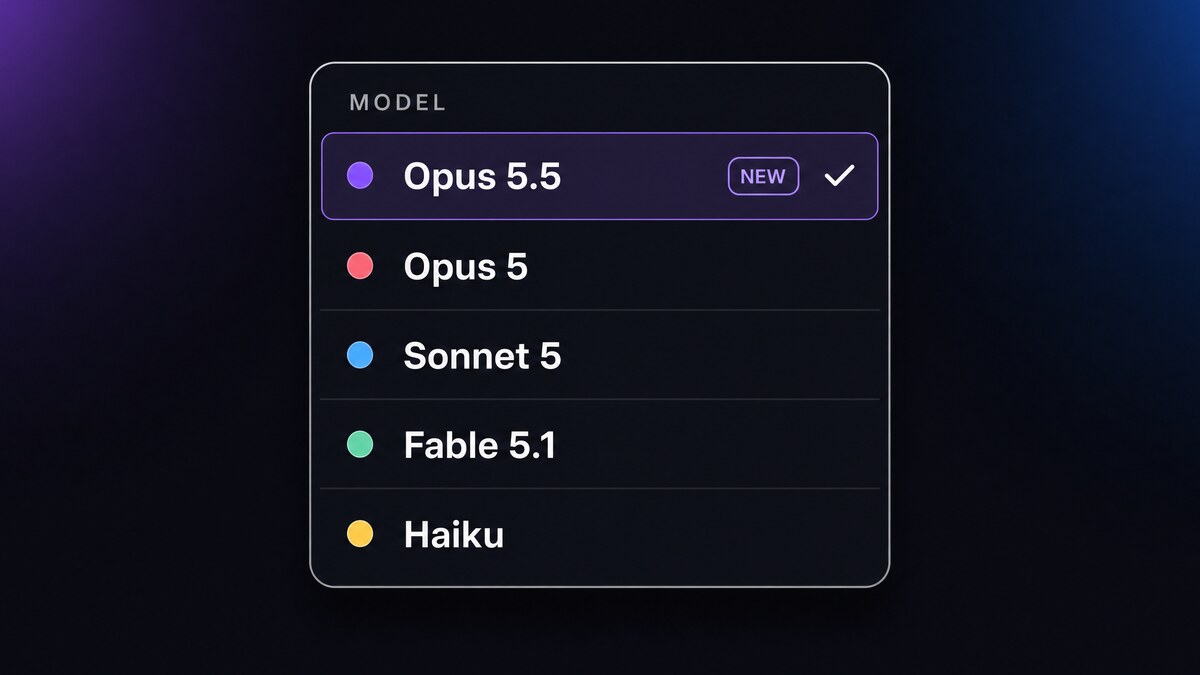
- Pick Opus 5.5 from the model menu, or choose the Opus option to always track the latest Opus automatically, which is now 5.5.
- Optionally set an effort level. It runs at our top reasoning tier by default.
- Send your message as normal. Delegation, artifacts, skills, and tools all work identically.
Availability
| Fact | Value |
|---|---|
| Availability | All CRHQ satellites |
| Live since | 2026-09-22 |
| Provider | Claude |
| Pricing | $4 in / $20 out per 1M tokens; cache reads $0.20 |
| Client action required | None. It is already live on your instance |